


DISPENSARY MARKETING

Dispensary marketing: the strategic guide

James Compton
Written by

James Compton

Chief Executive Officer


What dispensary marketing is in 2026, and why it is not brand marketing

A cannabis brand sells a product through other people's shelves and grows on awareness. A dispensary sells a location and grows on proximity, availability and habit. How to market a dispensary is therefore a local question before it is a creative one: who within a drive of your door is searching right now, what do they see, and what makes them come back.

That framing rules channels in and out. National reach is wasted on a store with a fifteen-minute catchment. A good billboard cannot fix a Google Business Profile with the wrong category. And a discount posted to a marketplace trains customers to shop the marketplace, not you.

The status quo for most stores is a rented four-vendor stack: a marketplace listing, a menu vendor, a loyalty or SMS SaaS, and a generalist retainer. Third-party estimates put Weedmaps placements at $500–$5,000+ per month (Sparks Agency, 2026 edition), Dutchie e-commerce at $299–$1,000 per location per month (PricingNow, 2026-03-08) and Alpine IQ at about $1,000 per location per month (Heady, 2026-06-01). Each vendor reports its own numbers; nobody reports the store's.
Is it illegal to advertise cannabis?

No, not in itself, but the rules are layered and the answer depends on where the ad runs. Cannabis remains federally controlled, so there is no federal advertising framework to rely on. Each legal state sets its own rules: audience-composition thresholds for billboards and broadcast, bans on appealing to minors, required warnings, and limits on claims and giveaways. Municipal rules can be stricter again.

On top of state law sit platform policies. The major ad networks and most social platforms restrict or prohibit paid promotion of THC products, and organic accounts get suspended for menu posts. Search is the narrow exception: across the 24 head terms a dispensary competes for, the results pages carried no paid ad at all (September 2026), which leaves organic and local rank carrying the traffic.

The top of that results page is earned, not bought — and Dispenza does not sell paid search for dispensaries. Google's Dangerous products or services policy (read 2026-09-07) prohibits ads promoting recreational drugs, including THC products, and ads that facilitate their sale; Meta, X and LinkedIn each prohibit paid THC promotion under their own policies, with only narrow licensed or CBD exceptions. It is our position that accounts that keep pushing against those policies end up suspended and rebuilt, and each rebuild resets whatever progress the account had. That is why the channel map below carries no paid line: the budget belongs in the local pack, the menu-connected site and retention.

Two pages carry the detail: dispensary advertising rules by state and the cannabis marketing compliance guide. Read your state's row before you brief any creative.

Channel map: what works for licensed dispensaries

Cannabis dispensary marketing that produces orders concentrates in seven channels. In rough order of return for a single store:

  • Local SEO and the Google Business Profile — the local pack for "dispensary near me" and the category terms around it. Owned, compounding, measurable.
  • Your website and menu — the page the profile sends people to, and the place the order should happen. Owned.
  • Email — the lowest-cost repeat channel where the list is consented and the platform is cannabis-friendly.
  • SMS — the highest-response repeat channel, under the strictest consent and quiet-hours rules.
  • Loyalty — the program that turns a first visit into a habit and gives you a customer record.
  • Creative: brand and package design — what people remember after the first visit, and what shows up in the photos on the profile.

Digital marketing for cannabis retail is the first six of those; the seventh feeds all of them. What is missing from the list is deliberate: general social advertising, influencer spend and national display, which are either blocked for THC products or unmeasurable for one location.

Local search first: the map pack, "dispensary near me" and Share of Local Voice

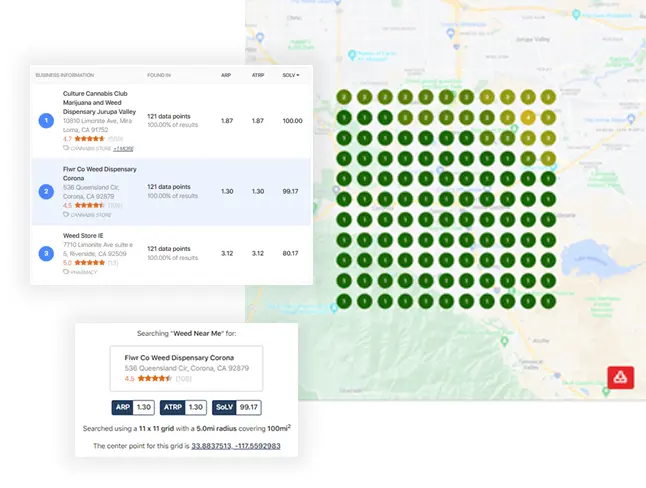
Three profiles appear above the organic results on a local search, and most customers do not scroll past them. Getting into that pack across your whole radius, not just at your own address, is the first job of dispensary marketing and the one with the clearest payback.

The work has four parts, and they are the four lines on Dispenza's plan plate: "Localized On-Page SEO / 100+ Off-Page SEO (Profiles) / Google Business Profile Management / Monthly and Quarterly Reporting". The profile gets the right categories, services, photos, posts and review replies. The citations underneath it get made consistent.

The site gets city and neighbourhood pages. And the result is measured as Share of Local Voice (SoLV) — the share of local-pack positions you hold for "Dispensary Near Me" across a grid of points in your radius, reported with its window, the way the case pages do.

The service pages: dispensary SEO with a written top-3 local ranking guarantee (Terms apply), dispensary local SEO and GBP management, and the Google Business Profile guide for dispensaries.

Your website and menu: own the order

The profile wins the click; the site has to win the order. A dispensary site has to do four things: load fast on a phone, show a menu that is indexable and current, take the pre-order or delivery order on your own domain, and satisfy the state's age gate and disclaimer rules without hiding the content from Google.

The menu is the part most sites get wrong. An embedded third-party menu that renders inside a frame gives Google nothing to index and gives the marketplace the customer. A menu-connected site pulls products from your POS or e-commerce provider into pages on your own domain, so staff update it themselves and the product pages rank. Built on SGEN — the platform every one of Dispenza's 500+ dispensary sites runs on — that is the default, not an upgrade.

Deeper: dispensary website design.

Retention: email, SMS and loyalty under one contract

Acquisition is expensive. New Frontier Data (2026-06-21) put one operator's cost per new customer at about $23. Retention is where the margin lives, and it runs on three channels that work best as one system.

  • Dispensary email marketing — welcome series, weekly drops, win-backs, on a cannabis-friendly platform with a consented list. See dispensary email marketing.
  • Dispensary SMS marketing — short, timed, opt-in only, quiet hours respected, with a clear stop keyword. See dispensary SMS marketing.
  • Dispensary loyalty marketing — points and tiers designed against your margin, connected to the POS so points post automatically, and messaged through the two channels above. See dispensary loyalty marketing.

Local SEO, menu-connected websites, email, SMS and loyalty under one contract. The reason that matters is not convenience; it is attribution. When the same report shows the ranking gain, the visits it produced and the repeat rate of the customers it brought in, budget decisions stop being arguments.

Budget: how much dispensary marketing costs

There is no single number, and anyone who gives you one without asking about your locations is guessing. What can be said with sources:

  • Third-party estimates put the DIY stack for a single location — marketplace, menu vendor, loyalty/SMS SaaS and a retainer — at roughly $3,800 to $27,000 per month before any website build (equivalence of the dated estimates above; each is an estimate, not a rate card).
  • Dispenza does not publish figures on this page. Pricing is scoped to your locations; every module in both plans is listed in full.

A sensible split for a single store puts the largest share into the owned local layer (profile, citations, site and menu), the second share into retention, and a variable share into creative. An illustrative split, not a recommendation for your store:

Full breakdown with the dated ranges: what dispensary marketing costs.

Measurement: what to report monthly, and a 90-day starter plan

Report four things every month, and make each carry its unit, its window and its source:

  1. 01 Rankings and SoLV — position in the local pack for the agreed keyword set, and Share of Local Voice for "Dispensary Near Me" across the radius.
  2. 02 Profile actions — calls, direction requests and menu clicks from the Google Business Profile.
  3. 03 Orders and visits — sessions and pre-orders on your own domain, split by source.
  4. 04 Repeat rate — members returning per month, member versus non-member basket, redemption.

That is the shape of Dispenza's "Monthly + Quarterly Advanced Reporting & Attribution" line, described on the marketing reports page.

A 90-day starter plan for a store beginning from zero:

  • Days 1–30: fix the Google Business Profile (categories, services, hours, photos), audit citations, install analytics and call tracking, and baseline SoLV. Confirm the menu is indexable.
  • Days 31–60: publish city and neighbourhood pages, start the review-reply and request cadence, launch the welcome email series and SMS opt-in at the counter.
  • Days 61–90: launch the loyalty structure, run the first segmented win-back, and produce the first full monthly report against the baseline.

What that looks like when it compounds: +180% increase in website visits — Firehouse 365 case page. 500+ dispensary sites built across the country, all on SGEN. The named studies are at dispensary marketing case studies.

FAQ

Is it illegal to advertise cannabis?

Not in itself. Cannabis is federally controlled, so there is no federal advertising permission, but each legal state sets its own advertising rules: audience thresholds, no appeal to minors, required warnings, limits on claims and giveaways. Platform policies add a second layer, restricting paid promotion of THC products on most networks. Advertising is legal within your state's rules and the platform's policies; the state-by-state guide lists the rules that apply to you.

What cannabis product sells the most?

It varies by state, by format regulation and by store, so a national answer is not useful for your plan. In most state sales reports flower carries the largest dollar share, with vapes and edibles behind it, and the order shifts by market and by year. The better question is what sells most in your store: pull category share, basket size and repeat rate by category from your POS, then market the categories that bring people back, not only the ones with the largest first-visit share.

Who is the biggest cannabis influencer in the United States?

We do not track a ranking, and for a dispensary it is the wrong question. Influencer content about THC products runs into the same platform policies as paid ads, and national reach does little for a store with a local catchment. If you work with creators, keep it local, disclose the relationship, follow your state's rules on depictions and claims, and measure it like any other channel: visits and orders, not followers.

Want it done for you?

  • The service behind this guide

    Dispensary SEO with a written top-3 local ranking guarantee

    Share of Local Voice grid for a dispensary search across a store radius, from a Dispenza search performance report

About the author

James Compton

James Compton

Chief Executive Officer

James Compton is Chief Executive Officer of Dispenza, the cannabis marketing agency for licensed dispensaries, and is responsible for the whole-strategy view this guide sets out: which channels a licensed dispensary can actually use, and the order to fund them in. To talk through the plan for your own stores, start a conversation with the team.