A cannabis SEO strategy in 2026 is a local strategy with a technical spine. Paid slots are empty on the terms that matter, the local pack decides who gets the call, and the menu pages most dispensaries never index are the pages with buyer intent. This guide explains cannabis SEO layer by layer so you can audit your own site, find the layer holding your rankings back, and brief an agency or your own team with specifics instead of buying "SEO" blind.
Written by
James Compton
Chief Executive Officer
What is cannabis SEO?
Cannabis SEO is the work of making a licensed dispensary, brand or ancillary business visible in Google's organic and local results for the searches its customers run. It uses the same mechanics as any SEO: crawlable pages, relevant content, authoritative links, a well-managed Google Business Profile. Three things make it different.
Restricted paid channels. Most of the demand has to be captured organically, which raises the value of every ranking position.
Local intent dominates. "Dispensary near me", "dispensary open now", "your-city dispensary" and product-plus-city searches are the money terms, and the local pack answers them before the organic links do.
The menu is the catalogue. A dispensary's product pages live inside a menu vendor's system. Whether those pages sit on your domain and get indexed, or sit in an embedded frame and do not, is the single biggest technical fork in cannabis SEO.
For the dispensary-specific version of this work, the dispensary SEO guide covers the local mechanics in more depth.
Why 2026 is different
Across the 24 head terms a cannabis business competes for, not one results page showed a paid ad (September 2026); the organic and local positions took all of the traffic. That is what those 24 queries looked like, not a statement about ad policy. What it means for a strategy is plain: there is no paid fallback for the head terms, so the organic and local positions are the whole game.
Two other shifts shape the year.
AI Overviews sit above the organic links on informational queries. For a dispensary, that affects education content, not the transactional and local searches that drive orders. It rewards pages that answer a question directly, in the first paragraph, with a source.
The local pack is the front page. On a phone, the three map results fill the screen before any organic listing appears. A cannabis SEO strategy that treats Google Business Profile as an afterthought is optimizing the second page.
The five layers of a cannabis SEO strategy
Every ranking problem we see on a dispensary site sits in one of five layers. Audit them in this order.
1. Technical
Can Google crawl and index the pages that sell? Check: menu and product pages on your own domain and indexable; one canonical URL per page; no indexable search-result or filter URLs; clean sitemaps; page speed measured with a named tool and date rather than asserted. A menu-connected SGEN site is built so that the menu is part of the indexable site rather than a frame inside it; see dispensary website design.
2. On-page
Does each page target one search intent with a title, H1 and body that match how people search? For a dispensary that means city and neighbourhood pages, category pages (flower, edibles, concentrates, pre-rolls), and a homepage title that names the business type and the city. Localized On-Page SEO is the plate line for this work.
3. Local and Google Business Profile
Is the profile complete, categorized correctly, reviewed often and answered always? Are your name, address and phone identical across 100+ Off-Page SEO (Profiles)? Google Business Profile Management is the layer with the fastest visible effect on the local pack. Details in the Google Business Profile guide for dispensaries and the local SEO service page.
4. Content
Do you publish pages that answer the questions your customers ask before they buy: strain guides, dosing basics, what is legal in your state, first-visit FAQs? Content earns informational rankings, feeds AI Overviews with your name attached, and gives the authority layer something to link to.
5. Authority
Do other relevant sites link to you: local press, directories, industry publications, brands you stock, event partners? Authority is slow, and it compounds. It is the layer that separates two dispensaries with equally good sites.
What are the top 5 SEO strategies?
Ranked for a dispensary, the top five strategies are the five layers in the order they pay back.
1. Fix the technical layer first, because nothing else works on pages Google cannot index. Menu pages on your domain, one canonical per page, junk URLs removed.
2. Own your Google Business Profile, because the local pack answers the money searches. Categories, hours, photos, products, review replies and posts where policy allows.
3. Build the local on-page set: one page per city or neighbourhood you serve, one per major category, each with a title that matches the search.
4. Publish answer content for the questions with no paid competition: legality by state, first-visit guides, product education.
5. Earn authority steadily: local press, supplier and brand pages, directories with real traffic, community sponsorships with a link.
Generic SEO advice often puts content first. For a dispensary, content without an indexable menu and a managed profile is a blog nobody finds.
Cannabis SEO tips that move dispensary rankings
These are the cannabis SEO tips we apply first on a new client site, because they move the needle in weeks rather than quarters. Cannabis SEO marketing, in practice, is mostly this list done consistently.
Get the menu indexed. If your product pages are inside an embedded frame, Google is ranking your menu vendor, not you. Move the menu onto your domain.
Build category pages that read like landing pages. A flower category page with a short buyer's guide, filters and local delivery or pickup details outranks a bare product grid.
Set the primary GBP category correctly and add every secondary category you qualify for. Then keep hours, holiday hours and products current.
Fix citations before you build links. Inconsistent name, address and phone across the directory layer suppresses local rank regardless of link strength.
Reply to every review, with the product or service named when it is natural. Reply rate and recency are visible signals.
Keep review velocity steady with an in-store and post-purchase ask; a burst followed by silence looks unnatural and helps less.
Publish your state's legal FAQ page. It ranks for informational searches, and it earns links from local media that need a source.
Kill the junk URLs. Indexable site-search pages, filter parameters and empty blog indexes dilute the crawl and the authority you have earned.
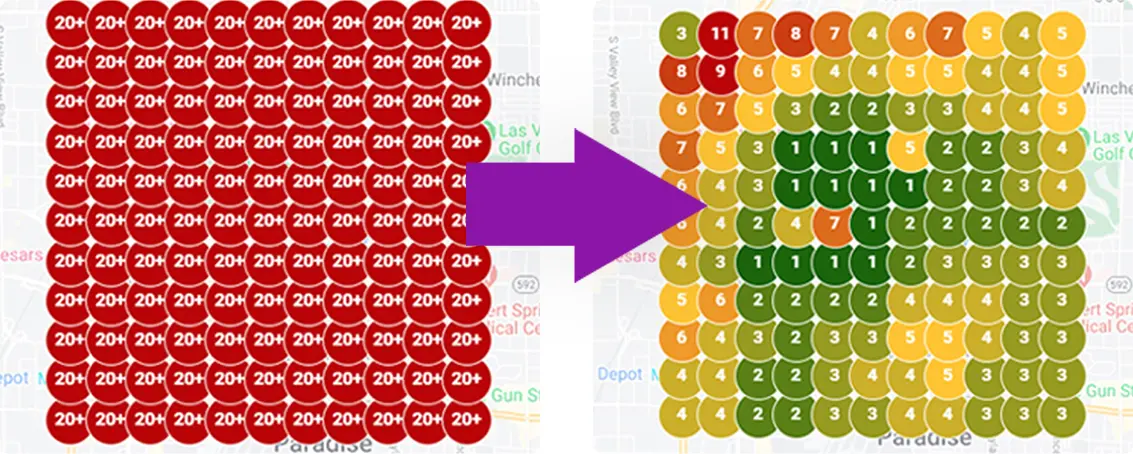
Measure by grid, not by one ranking check. Local rank changes block by block; a single check from your office tells you nothing about the customer two miles away.
What the sequence produces when the local and menu layers are fixed together, on a named case page: Share of Local Voice for "Dispensary Near Me" +45.59% over six months, with +241% direction requests printed in the same KPI block — NuLeaf NV case page. Read the NuLeaf case study.
+45.59%6moSHARE OF LOCAL VOICE FOR "DISPENSARY NEAR ME" — NULEAF NV
+241%DIRECTION REQUESTS — NULEAF NV
Measuring a cannabis SEO strategy
Rank reports for a dispensary should answer three questions: how visible are we in the local pack, where exactly, and what did it produce?
Share of Local Voice (SoLV) for "Dispensary Near Me" — the share of local-pack appearances your store earns across a grid of points in your radius, tracked monthly. This is the currency Dispenza case pages report, always with a window.
Map rank by grid point — the position at each point on the grid, so you can see where you drop out of the top 3 and target the on-page and citation work there.
Organic orders, calls and direction requests — the actions the rankings produced, read from Google Business Profile insights and the menu or POS. Rankings are the input; orders are the report.
Any performance figure in a cannabis SEO report should carry its tool and its date. A speed score with no tool named, or a ranking claim with no window, is not a measurement.
What are the top cannabis SEO companies?
There is no honest ranked list. The agencies that rank for "cannabis seo" rank because they work on their own marketing, and most of the results in between are agency blogs ranking their own authors. A top position for that phrase is a marketing result, not a client result: it tells you nothing about what the firm did for a dispensary.
A better question is scope. Some firms in the results serve the whole cannabis supply chain; others serve every industry and list cannabis as one vertical.
Dispenza is a cannabis marketing agency for licensed dispensaries. We work only on dispensary marketing, with 500+ dispensary sites built across the country, all on SGEN. Our proof lives on named case pages: +907% search impressions — Firehouse case page. Read the dispensary case studies and judge the scope against yours. Any ranking Dispenza claims for itself is Dispenza's own claim, dated, or it is not printed.
Doing it yourself vs hiring, and how to brief either
A single-location operator with a competent site and a few hours a week can run layers 3 and 4 alone: manage the profile, answer reviews, publish the state FAQ. Layers 1, 2 and 5 usually need someone who has done it before, because technical mistakes on menu pages are expensive to unwind and authority takes outreach.
Whichever way you go, brief with specifics:
Which layer is broken, from the audit above.
The target: top-3 local rank on a named keyword set, inside a named radius, by a named month.
The measurement: SoLV by grid, plus calls, directions and orders.
The deliverables, by name: Localized On-Page SEO, 100+ Off-Page SEO (Profiles), Google Business Profile Management, Monthly and Quarterly Reporting.
The platform: the site, the menu and the SEO in one contract, or three vendors and a coordination job you own.
The five-layer audit, in one list you can run this week:
1. Technical — the menu renders as HTML, junk URLs are out of the index, and the site passes a mobile lab test on a named date.
2. On-page — every page has one title-exact target, one H1, and the city in the copy where it belongs.
3. Local and Google Business Profile — categories match the store, hours match the door, and the profile is measured on a grid, not a single check.
4. Content — each guide answers one buyer question and links the service that fulfils it.
5. Authority — links from local, relevant sites, with spam and duplicate listings logged and reported.
Frequently asked questions
What are the top cannabis SEO companies?
There is no honest ranked list. The agencies that rank for "cannabis seo" rank because they work on their own marketing, and the results in between are agency blogs ranking their own authors. A top position for that phrase is a marketing result, not a client result. Judge on scope and proof instead: Dispenza works only with licensed dispensaries, with 500+ dispensary sites built across the country, all on SGEN, and points to named case pages rather than a ranking of itself.
What are the top 5 SEO strategies?
For a dispensary: fix the technical layer so menu and product pages are indexable on your domain; own your Google Business Profile; build local on-page pages for each city and category; publish answer content for the informational searches; and earn authority through local press, brand pages and directories. Run them in that order. Content before an indexable menu is a blog nobody finds.
What is the 80/20 rule in SEO?
The 80/20 rule in SEO says about 80 percent of your results come from about 20 percent of your work. For a dispensary the 20 percent is concrete: an indexed menu on your own domain, a complete and answered Google Business Profile, consistent citations, and one strong page per city and category. Most of the remaining effort refines those four; none of it substitutes for them.
How to grow your SEO?
Work a 90-day sequence. Days 1 to 30: technical audit, menu indexation, canonical clean-up, profile completion. Days 31 to 60: city and category pages, citation clean-up, review reply routine. Days 61 to 90: state FAQ and first answer content, first authority outreach, grid-based rank baseline. Then repeat, measuring Share of Local Voice for "Dispensary Near Me" and the calls, directions and orders it produced.
James Compton is Chief Executive Officer of Dispenza, the cannabis marketing agency for licensed dispensaries, and is responsible for the cannabis SEO approach set out above — the five layers, in the order the agency works through them with its own clients. To have your own site read layer by layer, start a conversation with the team.
Search
(function(){
function run(){ if (window.lucide && typeof window.lucide.createIcons === 'function') window.lucide.createIcons(); }
if (document.readyState !== 'loading') run();
else document.addEventListener('DOMContentLoaded', run);
setTimeout(run, 100);
})();