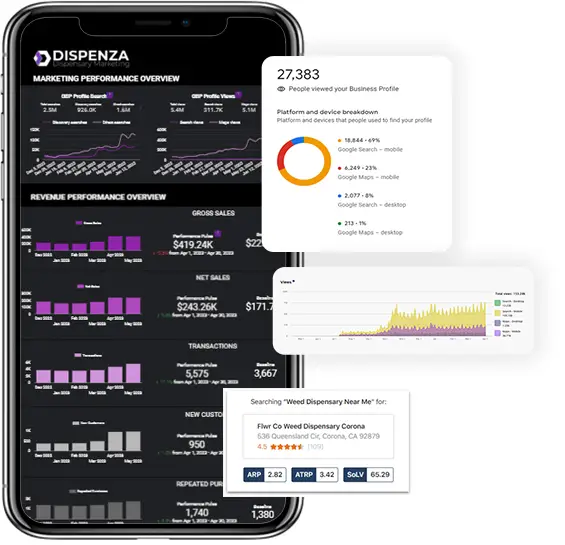
Here are some of the platforms and technologies we work with:
Point of Sale (POS)

Marketing Technologies
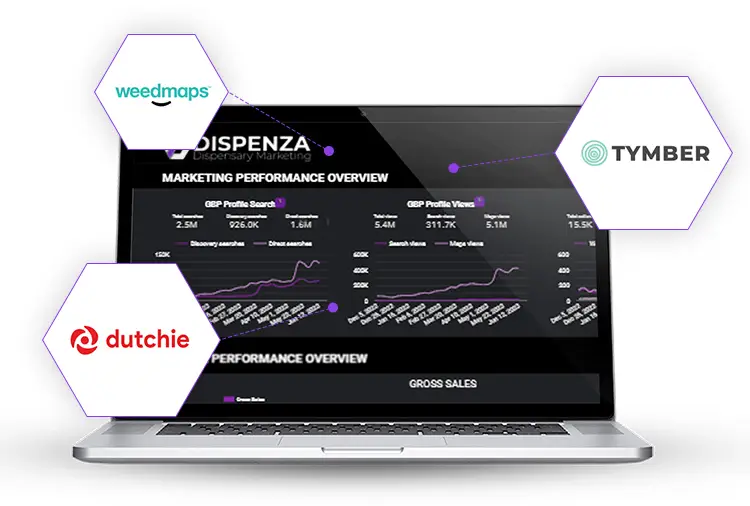
Menu and POS

At Dispenza, we understand the importance of seamless integration between different platforms and technologies for the success of your dispensary.
We work with a wide range of industry-leading POS systems, marketing technologies, and menu platforms to help you streamline operations, maximize efficiencies, and achieve your business goals. Our expertise in integrations ensures that you can make the most out of your existing tools and platforms while leveraging our digital marketing strategies to drive sales and growth.
Having built 500+ dispensary sites across the country, all on SGEN, we specialize in helping dispensaries optimize their operations and marketing efforts by integrating these platforms seamlessly.
Our team is experienced in working with these systems and can provide guidance and support to ensure a smooth transition and maximize the benefits of each integration.
With our expertise in platform migrations and integrations, we can assist you in moving from one platform to another, enabling you to leverage the latest technologies and functionalities that align with your business objectives.
Our goal is to help you achieve streamlined sales processes, enhanced customer experiences, and improved overall efficiencies.
Unlock Your Dispensary's Potential with Dispenza
We'll work closely with you to understand your unique requirements and provide customized solutions that drive growth and success in the competitive cannabis industry.
Most dispensary sites rent their menu. The vendor's widget sits in an embed Google cannot read, so every product, brand and strain page the store should rank for belongs to the vendor's domain. The POS updates stock, the site does not know, and the customer finds out at the counter. When the menu vendor goes down, the site goes dark with it, and you hear about it from customers first.
The pattern is the same in every case: the store that does not own its menu, its listing and its customer data pays rent on all three.
The menu becomes indexable page content
On SGEN the menu renders as real pages on your domain. Product, brand and category pages carry your titles, your schema and your internal links, so cannabis ecommerce marketing stops leaking authority to a vendor subdomain. A search for a strain or a brand in your city can land on your page instead of a marketplace.
One login for site, menu and loyalty data
Menu data, order data and loyalty membership sit behind one login. Staff update the site themselves. Your dedicated campaign strategist reads menu starts, cart adds and orders next to Share of Local Voice and GBP actions in one report.
Platform migrations without a rebuild
Menu vendors change. POS contracts end. On SGEN a vendor swap is an integration change, not a new website. Product data, URLs and redirects carry over, so the rankings you built on the old menu pages survive the switch.
The rows below cover the menu, POS and marketing-technology vendors dispensaries most often run. Vendor names are third-party trademarks; a row states what Dispenza connects, not a partnership. The exact scope for your vendor pair is confirmed in writing before the build starts.
| Vendor | Category | What the integration covers |
|---|---|---|
| Dutchie (dutchie website integration) | Menu platform and POS | Menu pages on your domain, stock and pricing synced from the POS, orders in the monthly report, migration on or off the platform |
| Jane / iHeartJane (jane menu integration) | Menu platform | Menu pages on your domain, catalogue sync, orders in the monthly report, migration on or off the platform |
| Treez | Point of sale | Inventory, pricing and compliance data synced to the site menu; migration between POS systems |
| Flowhub | Point of sale | Inventory and pricing synced to the site menu; migration between POS systems |
| LeafLogix | Point of sale | Inventory and pricing synced to the site menu; migration between POS systems |
| IndicaOnline | Point of sale | Inventory and pricing synced to the site menu; migration between POS systems |
| Blaze | Point of sale | Inventory and pricing synced to the site menu; migration between POS systems |
| Tymber | Menu platform | Menu pages on your domain, catalogue sync, orders in the monthly report |
| Dispense | Menu platform | Menu pages on your domain, catalogue sync, orders in the monthly report |
| Weedmaps | Menu and listing | Listing menu kept in step with the site menu; listing spend and actions read into the attribution report |
| Alpine IQ | Marketing technology (loyalty, SMS, email) | Site sign-ups land in the list, purchases update the tier, sends are attributed in the report |
| Springbig | Marketing technology (loyalty, SMS) | Site sign-ups land in the list, purchases update the tier, sends are attributed in the report |
| StrainBrain | Marketing technology (product recommendation) | Recommendation data connected to the menu pages on your domain |
What each category covers
Menu platforms:
The e-commerce layer customers order from. Connected as native pages on your domain, with product schema and your own URLs.
Point of sale:
Inventory, pricing and compliance reporting. Synced so the site never sells what the shelf does not hold.
Marketing technologies:
SMS, loyalty and email tools. Connected so sign-ups from the site land in the list and purchases update the tier.
Analytics and attribution:
GBP actions, site events, menu events and orders in one report: what ran, what it cost, what it returned.
The measurable effect of a native menu is ranking coverage: product and brand pages on your domain can rank; an embed cannot. The clearest first-party example is a delivery operator that replaced marketplace dependence with owned pages and local SEO: NorCal Holistics case study, where the case page records a 50% reduction in Weedmaps spend.
Built on SGEN — the platform every one of Dispenza's 500+ dispensary sites runs on. Because the platform and the agency sit under one contract, the integration work collapses three line items a dispensary usually rents separately:
The website build already includes any e-commerce or menu integration, 30-day backups and restores, web hosting and a dedicated project manager. Technology and integrations support is a named module in both plans.
Which menu providers do you integrate with?
The vendor table above covers Dutchie, Jane, Treez, Flowhub, LeafLogix, IndicaOnline, Blaze, Tymber, Dispense and Weedmaps on the menu and POS side, and Alpine IQ, Springbig and StrainBrain on the marketing-tech side. The scope for your vendor pair is confirmed in writing before the build. If your provider is not listed, ask on the demo call.
Can we switch POS without rebuilding the site?
Yes. On SGEN the site and the menu integration are separate layers. A POS or menu-vendor change is an integration swap: we remap product data, keep URLs and redirects, and re-point the sync. The pages, the rankings and the customer list stay where they are. The scope of the swap is confirmed per vendor pair on the demo call.
Does a native menu help SEO?
It changes what can rank. Product, brand and category pages rendered on your domain carry your titles, schema and internal links, so they can appear for strain, brand and product searches in your city. An embedded vendor menu gives that visibility to the vendor's domain. The case we point to is NorCal Holistics, where owned pages and local SEO displaced part of a marketplace budget.
Do you migrate our product data and redirects?
Yes. Migration means the product catalog, images and descriptions move to the new menu layer, every old menu URL receives a redirect to its new page, and the sync with your POS is re-tested before cutover. Backups are kept for 30 days as part of the website build. Timelines are scoped per vendor pair and confirmed in writing.
Are you a partner of these vendors?
No. Vendor names on this page describe what we connect, not a partnership, and Dispenza claims no partner or reseller status with any vendor listed here. Your contracts with those vendors stay yours.
Book straight into the calendar and we'll match you with whoever is free first. Technology and integrations support is a named module in both plans; pricing is scoped to your locations — how pricing works.