Performance marketing
Organic and local demand for a licensed dispensary.
- Localized On-Page SEO
- 100+ Off-Page SEO (Profiles)
- Google Business Profile Management
- Monthly and Quarterly Reporting
1,259 licensed storefronts. Three map positions.
A dispensary-only agency, working all of California. One team, one contract, every surface a shopper touches.
The numbers
1.2 BLN
SALES INFLUENCED
2.1 BLN
WEBSITE VISITS
3.8 BLN
GOOGLE IMPRESSIONS
500+
LOCATION HELPED
Two of twelve
Organic and local demand for a licensed dispensary.
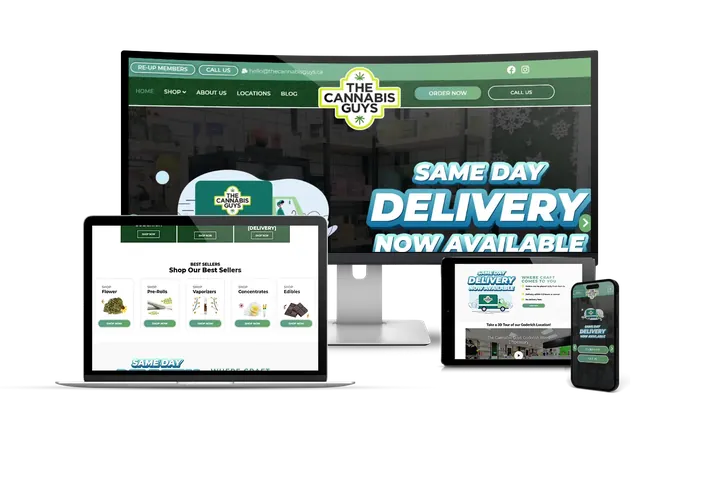
Menu-connected sites built to be updated by staff.
Services
California decides your month in two places: the three pins a shopper sees when she searches, and the reason she has to come back to you instead of the door she used last time. These twelve services work both ends of that for your store, three to rank it, four to build it, three to keep her returning and two to run the numbers, all on one contract, and the plans below show which modules each carries.
Rank
Build
Menu-connected sites on SGEN, updated by staff.
READ MOREMenu, POS, loyalty and analytics talking to each other.
READ MORETurning the traffic you already pay for into orders.
READ MOREIdentity, packaging and creative sized for every placement.
READ MORERetain
Performance benchmarks
Day 0
SoLV Weed Dispensary0.00
Direction Requests291
1 Month
SoLV Increase- Weed Dispensary100.00
Direction Requests Increase+100%
Day 0
SoLV Weed0.00
Direction Requests709
12 Month
SoLV Increase- Weed59.62
Direction Requests Increase+49.08%
Day 0
SoLV Weed Dispensary0.00
Direction Requests181
3 Month
SoLV Increase- Weed Dispensary93.37%
Direction Requests Increase+32.51%
Day 0
SoLV Weed Dispensary0.00
Website Visits291
1 Month
SoLV Increase- Weed Dispensary99.17
Website Visits Increase+100%
The plans
Both plans list every module they fold in, in full. Pricing is scoped to your locations — talk to a rep to get yours.
Most Popular!
Guaranteed results
Modules included
Full Suite
Guaranteed Results + Boost your retention
Modules included
Single-location dispensaries · multi-location dispensaries and MSOs · delivery dispensaries.
Nobody in California is making new cannabis buyers, so the shopper you want already has a favorite, and every sale you add is one a rival lost. Here is the size of that fight, and our move on each figure.
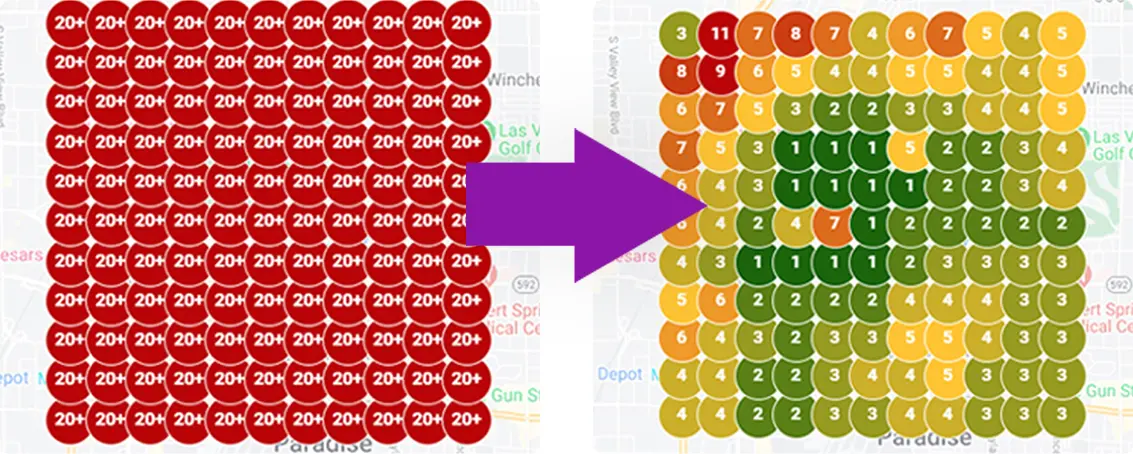
Above, four clients’ day zero against the month, in Share of Local Voice: the share of the local pack a store holds for "Dispensary Near Me" across its trade area.
Storefront, delivery and jurisdiction counts are the California Department of Cannabis Control's public license search and its local-ordinance file: the license search was refreshed on 8 September 2026 and is filtered to active licenses at premises in California; the ordinance file is dated 18 March 2026. Population is the US Census Bureau's Vintage 2024 estimate. All were read on 9 September 2026. No county or city storefront count appears here; every license count quoted is a statewide total. No statewide cannabis sales figure appears here, because none was taken from a California state publication.
1,259 storefronts, and not one new buyer.
The California Department of Cannabis Control recorded 1,259 active storefront retailer licenses on 8 September 2026, all of them selling to the same 39.4 million residents. So growth for you is not new demand arriving; it is a shopper picking your door over the one she used last month, and she picks from the three the map shows her first. Putting your pin in that three, for a keyword set and radius we agree with you, is what we guarantee.
More than half the state cannot open a store.
There is no statewide cap on how many stores may trade; each city and county rules on that itself, and the same agency's ordinance file, dated 18 March 2026, records 302 of 540 jurisdictions allowing no retail cannabis business at all. So the doors that do exist are crowded into a minority of the map, and nobody can honestly sell you one statewide campaign. We scope your keyword set, your rank grid and your monthly report to the trade area you actually pull from.
Your fight is a radius, not a state line.
California is a two-license state: your city or county has to authorize you before the state will license you, so who competes with you is settled street by street, not statewide. A Sacramento shopper never sees a San Diego pin, so the count that decides your month is the doors trading inside your own radius, not the statewide total. We work the three positions inside that radius for you, with the profile, pages and citations that decide them, and the guarantee written to that radius and an agreed keyword set.
Most dispensaries rent their marketing from four vendors and hope the pieces talk to each other. They rarely do.
California licenses 1,259 storefronts, but its own ordinance file records 302 of the state's 540 cities and counties allowing no retail cannabis business at all, so those doors are packed into a minority of the map, and renting your listing, your menu, your texting and your reporting from four vendors that never speak to each other is the expensive way to fight for a position on it.
You know the rules you sell under better than any agency does, so this page does not restate them. If you want the references, both are in the library: dispensary advertising rules by state and cannabis marketing compliance.
Your stack is rented from four vendors.
A marketplace listing, a menu vendor, a loyalty or SMS tool and a generic retainer, each with its own login. Fix: one platform (SGEN) and one agency, with the site, the menu and the campaigns in one place.
Local SEO is an upsell tier elsewhere.
The work that puts you in the local pack for "Dispensary Near Me" is often gated behind the top plan. Fix: ranking work is included from the first dollar. Localized on-page SEO, 100+ off-page profiles and Google Business Profile management are in both plans.
Menu traffic leaks to marketplaces.
A shopper who finds your store on a third-party listing is that listing’s customer. Fix: menu-connected SGEN sites keep the order on your domain, with staff updating the menu themselves.
Four invoices, four account managers.
Nobody owns the result. Fix: one point of contact, one monthly report showing what ran, what it cost and what it returned.
Web design and development are included — no separate build fee.
Local SEO, menu-connected websites, email, SMS and loyalty under one contract.
New Frontier Data (2026-06-21) put one operator’s cost per new customer at about $23. So we manage the channel that costs the least per visit: the local pack.
Our currency is Share of Local Voice (SoLV) for "Dispensary Near Me" — the share of local-pack visibility your store holds for that search across its trade area, reported with its window and case page.
The twelve services above are the same in every market; what changes for you is the scope, and in California the scope is never the state. Your keyword set, your radius, your pin count and the shape of your monthly report are drawn to the trade area your store actually pulls from, and the top-three guarantee is written to that same scope.
If you run one store.
Your city or county decided whether you could open at all, and more than half of California's jurisdictions decided against retail altogether, so the doors that survived sit in clusters rather than spread evenly across the map. That is your advantage and your problem at once: fewer rivals inside the county line, more of them competing for the same handful of streets. Your store gets its own keyword set, its own Google Business Profile, its own citation set and its own rank grid across the radius your shoppers come from, with Share of Local Voice for "Dispensary Near Me" reported point by point every month, so you can see which streets you hold and which a rival holds. See marketing for the single-location dispensary.
If you run several.
Each store you run in California sits under its own city or county, and the map splits the same way: your Sacramento store and your Palm Springs store are never in the same local pack, so one statewide number tells you nothing about either. We mirror that shape instead, with one SGEN domain and a store selector, one page and one Google Business Profile per location, one citation set per address, and a roll-up report carrying a row per location, so a store holding share and one quietly losing it are never averaged into the same line. The guarantee is written the same way: per location, per keyword set, per radius. See marketing for multi-location dispensaries and MSOs.
If you deliver.
The same September license search records 203 active non-storefront retailer licenses in California, which means your rival is rarely the shop on the corner and usually every delivery operator whose service area overlaps yours. What you sell against is a footprint rather than a shopfront, so we draw the rank grid to the area you actually serve and work the pack that shows inside it, with a menu-connected site, email and SMS doing the returning that a window and a counter do for a storefront. Bring your license to the demo call and we scope the grid to it there. See marketing for delivery dispensaries.
Six pressures on a California dispensary, what each one takes out of your till, and the move we make on it, all inside one contract and under a top-three local ranking guarantee written to an agreed keyword set and radius. Our method is in the guide behind each one, if you want it before you book the call.
However many doors open, the map still shows three
However many storefronts California licenses, a shopper still sees three pins and takes one tap. Those three are decided by work that costs you effort rather than budget: a complete profile, the right primary category, hours and attributes that match reality, products and posts kept current, and questions answered before a rival answers them for you. We run that profile as a live surface for your store rather than a form filled in once, and we start there, because everything else you pay for gets less out of a half-built listing. See the guide: Google Business Profile for dispensaries.
The highways are closed, so the money moves to the map
California puts an audience test on your advertising, at least 71.6% of the people who see it reasonably expected to be 21 or over under Business and Professions Code 26151, and Code 26152 keeps your signs off interstate and border-crossing state highways and away from schools, playgrounds and youth centers. Read as rules, that is a wall; read as a buying spec, it tells you which inventory to skip before you pay to find out. The money goes instead to the three surfaces with no audience threshold on them, the map, your own site and the list you own, and we run all three for you on one contract. See the guide: dispensary advertising rules by state.
540 local decisions, and none of them draws your map
Every city and county here rules for itself on cannabis retail, which is why a state-level plan is worth nothing to you: 302 of those 540 jurisdictions allow no retail cannabis business, and the ones that do sit beside ones that do not, so the pack a shopper sees is drawn around her rather than around any line on a state map. The order of operations we run is fixed, the profile, then the pages a shopper types her way to, then the citations, then the links, and doing it out of order costs you the year. See the guide: the dispensary SEO guide.
Your shopper is not a first-timer working it out
California legalised medical cannabis under Proposition 215 in 1996 and adult use under Proposition 64 in 2016, so the buyer you are chasing has had years of practice at this. She knows what she likes, she has a store she defaults to, and she leaves it for one of two reasons: yours came up first in her search, or yours gave her a reason to return and hers did not. A points or tier structure wired into your POS, with the email and SMS that keep it warm, is the one asset no rival can outrank you for, because it is a relationship rather than a position. That layer is what separates our two plans. See the guide: the dispensary loyalty program guide.
California wants proof of age before you message anyone
Direct communication here has to be age-affirmed before it goes out, which reads as friction until you notice what it buys you: a list of people who have already said they are old enough and want to hear from you. That list does not get dearer when a rival raises a bid, and it is the one channel a competitor cannot take off you by ranking better. We build the capture into your site and your counter, then run the email and SMS off it, so the shopper who came in once has a reason to come back before she goes looking again. See the guide: cannabis-friendly SMS platforms.
Four invoices, one map position
A marketplace listing, a menu tool, a texting platform and an agency retainer each bill you every month whether or not any of them moved your rank, and none of the four talks to the others, so you pay four times to chase one position. What each rented piece actually costs, from dated third-party sources, is set out in the guide. Both of our plans put the site, the ranking work, the retention layer and the reporting on one contract, with the web build included and no separate build fee, so the money you were spending on overlap goes into work that moves your pin. See the guide: what dispensary marketing costs.
New to hiring an agency? Read the dispensary marketing guide or browse all dispensary marketing guides.
Do you guarantee rankings?
A written top-3 local ranking guarantee — Dispenza’s own offer; the keywords, radius and time window are set in your agreement (see terms). Terms apply. Ask for the guarantee terms on your demo call before you sign anything. The guarantee covers the local keyword set agreed for your trade area, over a defined window.
Which platform are the sites built on?
Built on SGEN — the platform every one of Dispenza’s 500+ dispensary sites runs on. SGEN is Dispenza’s in-house website platform, so the team that hosts your site is the team running your campaigns. Menu-connected sites are built to be updated by staff.
What does it cost?
Pricing is scoped to your locations and both plans above list every module in full, with the site build included and no separate build fee. A quote for your store count takes one demo call. See how pricing works.
More than half of California's cities and counties allow no retail store. Does that help us or hurt us?
Both, and the balance is settled on the map rather than in the ordinance. Fewer towns open means fewer rivals inside your county line, but it also means the ones trading are stacked into the same clusters, competing for the same shoppers. What that changes for you is where the fight sits: not the state, but the grid of points around your own address. We draw that grid on the demo call, count the doors actually in it, and scope the top-three guarantee to that keyword set and radius.
We run stores in three California cities. Is that one program or three?
Three maps, one contract. Each of your locations sits under a different city or county and appears in a different local pack, so each gets its own keyword set, its own Google Business Profile, its own citation set and its own rank grid, and the monthly report carries a row per location rather than one averaged number. You still deal with one team and one invoice. We follow your addresses with the work and roll the reporting up, so you can see at a glance which location is holding share and which is not.
There are more than a thousand licensed storefronts in California. How is top three realistic?
Because you are never competing against a thousand of them. The local pack is drawn around the person searching, so the fight that decides your month is the handful of doors trading inside your own radius, and in a state where more than half the cities and counties allow no retail store at all, those doors sit in clusters rather than evenly across the map. We size that handful for your own address before anything is scoped, and the written top-three guarantee is held to that radius, an agreed keyword set and a window.
California puts an audience test on our advertising and keeps our signs off the highways. Where should the budget go?
To the three surfaces that carry no audience threshold at all: the local pack, your own website, and the list of people who asked to hear from you. None of them depends on buying inventory that has to be certified 21-and-over first, and all three compound instead of stopping the day you stop paying. That is what our twelve services are built around, and the plans above show which modules sit in each.
How is the guarantee written for a California store?
To a scope you agree before you sign: a named keyword set, a radius around your address, and a window. Inside that, the offer is a top-three position in the local pack, and terms apply. It is never written to the state, because no store ranks statewide, and it is never a promise about your takings. We sell rank; what rank is worth at your counter is something we model with you on the call rather than promise you in an advertisement.

Book straight into the calendar. Bring your store count and your address; you leave the call with a quote scoped to your locations and the guarantee terms to read before you sign.
More markets
Other California markets first, then the rest. Every market page is written to its own store count and its own map, and the guarantee is written to yours.
Where the doors are, by licensed storefronts: Los Angeles 149, San Francisco 66, Sacramento 37, Long Beach 31, San Diego 29, Santa Rosa 23, Santa Ana 21, San Jose 19, Costa Mesa 18, Fresno 17, La Mesa 15, Palm Springs 13, Modesto 11, Oakland 11, Vista 11, Moreno Valley 10, Oxnard 10, Ukiah 10, Cathedral City 9, Corona 9, Hemet 9, North Hollywood 9, Needles 9, West Hollywood 9 and 242 more. Every number here is counted from California Department of Cannabis Control licence register, read 2026-09-10. If your city is on that list, the fight for its map is already running.
Long-term relationships built on trust, transparency, & results
We get it, the digital marketing and cannabis industries don't always have the most dependable people to rely on. That's why at Dispenza, we back up what we say with results.