Performance marketing
Organic and local demand for a licensed dispensary.
- Localized On-Page SEO
- 100+ Off-Page SEO (Profiles)
- Google Business Profile Management
- Monthly and Quarterly Reporting
66 licensed storefronts. Three map positions.
A dispensary-only agency, working all of San Francisco County. One team, one contract, every surface a shopper touches.
The numbers
1.2 BLN
SALES INFLUENCED
2.1 BLN
WEBSITE VISITS
3.8 BLN
GOOGLE IMPRESSIONS
500+
LOCATION HELPED
Two of twelve
Organic and local demand for a licensed dispensary.
Menu-connected sites built to be updated by staff.
Services
All twelve run for the same store, on one contract, on your own domain: the search work that wins the tap, the site that takes the order, the channels that bring her back, and the report that shows you what moved. Open any row for its service page; the two plans set out which rows your contract carries.
Rank
Build
Menu-connected sites on SGEN, updated by staff.
READ MOREMenu, POS, loyalty and analytics talking to each other.
READ MORETurning the traffic you already pay for into orders.
READ MOREIdentity, packaging and creative sized for every placement.
READ MORERetain
Performance benchmarks
Day 0
SoLV Weed Dispensary0.00
Direction Requests291
1 Month
SoLV Increase- Weed Dispensary100.00
Direction Requests Increase+100%
Day 0
SoLV Weed0.00
Direction Requests709
12 Month
SoLV Increase- Weed59.62
Direction Requests Increase+49.08%
Day 0
SoLV Weed Dispensary0.00
Direction Requests181
3 Month
SoLV Increase- Weed Dispensary93.37%
Direction Requests Increase+32.51%
Day 0
SoLV Weed Dispensary0.00
Website Visits291
1 Month
SoLV Increase- Weed Dispensary99.17
Website Visits Increase+100%
The plans
Both plans list every module they fold in, in full. Pricing is scoped to your locations — talk to a rep to get yours.
Most Popular!
Guaranteed results
Modules included
Full Suite
Guaranteed Results + Boost your retention
Modules included
Single-location dispensaries · multi-location dispensaries and MSOs · delivery dispensaries.
Nobody is making new cannabis buyers in San Francisco, and since 2023 nobody has been able to apply to open a new store here either, so every basket you win is one a rival lost. Here is the size of that fight and our move on each figure.
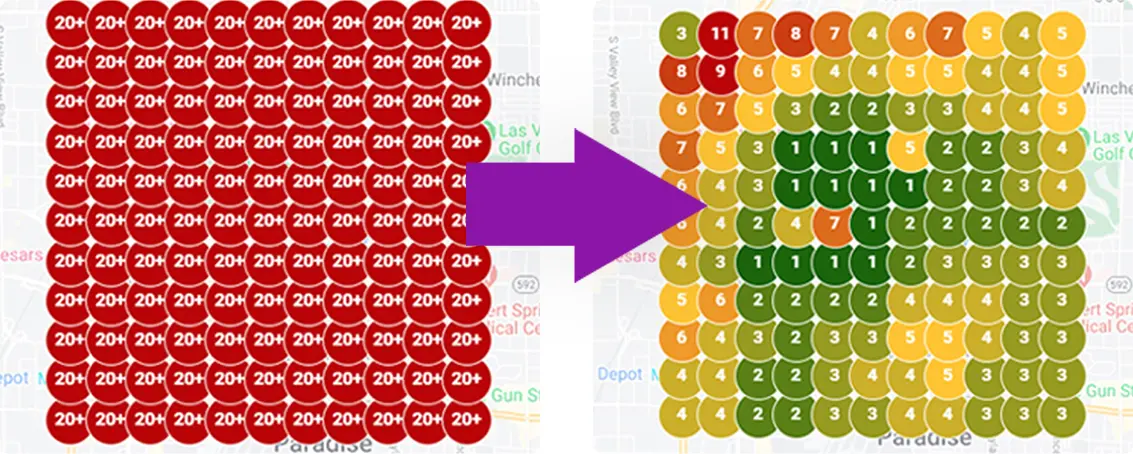
Above, four clients’ day zero against the month, in Share of Local Voice: the share of the local pack a store holds for "Dispensary Near Me" across its trade area.
License counts are the California Department of Cannabis Control's public license search, data refreshed 8 September 2026 and re-read against the live register on 10 September 2026, filtered to active licenses at premises the department records in San Francisco County: 70 active storefront retailer licenses standing at 66 distinct premise addresses, six non-storefront retail licenses and ten microbusinesses inside 108 active licenses of every type. Those are state licenses at San Francisco premises rather than city permits; the San Francisco Office of Cannabis publishes no count of the permits it has issued, so no permit count appears here. Population is the US Census Bureau's Vintage 2025 estimate and land area its 2024 Gazetteer file. Ordinance 200144 and the cannabis cafe ordinance are the Board of Supervisors' own legislative records, but the cafe's 23 August 2026 effective date is not on that record: it is the city's 31-day rule applied to the mayor's approval, corroborated in independent reporting. The 1 January 2036 tax date is the Treasurer and Tax Collector's. No regulator publishes a San Francisco cannabis sales figure, so none appears here.
Seventy licenses, sixty-six doors.
The state's public license search, refreshed 8 September 2026, records 70 active storefront retailer licenses at San Francisco premises standing at 66 distinct addresses: four addresses hold two licenses each, one adult-use and one medicinal. Ordinance 200144 has blocked new retail applications since 23 July 2023 and runs to 31 December 2027, so no new storefront application can be filed while it stands. Every search still shows three pins; putting yours in that three, for a keyword set and radius we agree with you, is what we guarantee in writing.
The city zones your rivals apart.
Article 16 of the Police Code keeps a storefront 600 feet from a school and 600 feet from the next cannabis storefront, so the edge of your trade area is drawn by the city and no rival can move nearer. What is left is 66 storefront premises across 46.685 square miles, one for every 12,516 residents against one per 31,259 statewide. You cannot out-locate anybody here, only out-rank them, which is why both plans lead with search and profile work, not placements.
Down on 2020, up on 2024.
San Francisco held 875,139 residents in 2020 and 826,079 in 2025: 49,060 fewer, though 5,134 more than in 2024, so the fall has reversed. This county carries 5.56% of California's active storefront retailer licenses on 2.10% of the state's population, so the field you face per customer is thicker than any state average tells you. Our monthly report shows which searches you are winning and which are handing your sale to somebody else.
Most dispensaries rent their marketing from four vendors and hope the pieces talk to each other. They rarely do.
San Francisco is one government, one permit authority and one zoning map across all 46.685 square miles of it, so every rival you have trades under identical rules and execution is the only variable left, which makes renting your listing, your menu, your texting and your reporting from four vendors who never speak to each other an expensive way to hand that variable away.
You know the rules you sell under better than any agency does, so this page does not restate them. If you want the references, both are in the library: dispensary advertising rules by state and cannabis marketing compliance.
Your stack is rented from four vendors.
A marketplace listing, a menu vendor, a loyalty or SMS tool and a generic retainer, each with its own login. Fix: one platform (SGEN) and one agency, with the site, the menu and the campaigns in one place.
Local SEO is an upsell tier elsewhere.
The work that puts you in the local pack for "Dispensary Near Me" is often gated behind the top plan. Fix: ranking work is included from the first dollar. Localized on-page SEO, 100+ off-page profiles and Google Business Profile management are in both plans.
Menu traffic leaks to marketplaces.
A shopper who finds your store on a third-party listing is that listing’s customer. Fix: menu-connected SGEN sites keep the order on your domain, with staff updating the menu themselves.
Four invoices, four account managers.
Nobody owns the result. Fix: one point of contact, one monthly report showing what ran, what it cost and what it returned.
Web design and development are included — no separate build fee.
Local SEO, menu-connected websites, email, SMS and loyalty under one contract.
New Frontier Data (2026-06-21) put one operator’s cost per new customer at about $23. So we manage the channel that costs the least per visit: the local pack.
Our currency is Share of Local Voice (SoLV) for "Dispensary Near Me" — the share of local-pack visibility your store holds for that search across its trade area, reported with its window and case page.
The twelve services are the same wherever you trade. What changes here is that your scope has no soft edges, one government and one zoning map with the retail application window shut by ordinance, so the whole plan is written to your own address and its own grid rather than to a boundary your shopper cannot see.
If you run one store.
Your county line is your city line, so there is no suburb with a friendlier rulebook to move into and no unincorporated fringe to expand into; the contest is the few blocks around your door. The state register spreads those 70 licenses across 18 ZIP codes, nine of them in the busiest and one apiece in the three lightest, which is how uneven your side of the map really is. We write your keyword set, your landing page and your Google Business Profile to the place your door opens onto, draw the rank grid around your own radius rather than a county boundary no shopper can see, and report Share of Local Voice across that grid every month. See marketing for the single-location dispensary.
If you run several.
A second San Francisco storefront cannot simply be applied for while the freeze on new retail applications runs to 31 December 2027, so another door here comes only from taking over one that exists, and 17 addresses already belong to a name running more than one shop in the city. You get one SGEN domain with a store selector, a page and a Google Business Profile per address, a citation set per address and a roll-up report with a row for each, so your quieter shops stop averaging into your best one, and the top-three guarantee is written per location, to that location's own keyword set and radius. See marketing for multi-location dispensaries and MSOs.
If you deliver.
Six non-storefront retail licenses are active in this county against sixty-six storefront addresses, and a delivery footprint has no pin to rank: you show up in the results or you show up nowhere. So we measure your visibility across a service-area grid, zip by zip, with order starts from your own menu-connected site beside it, and we write the guarantee to that grid, its keyword set and its window. What we will not do is let a marketplace keep the customer you paid to reach. See marketing for cannabis delivery dispensaries.
Six ways this city's own rules and its own arithmetic show up in your till, and the move we make on each one under a top-three guarantee written to your keyword set, radius and window. Each one links the guide behind it, if you would rather read the method than hear it.
Your rivals are zoned apart, so the pin is won on the work
The city keeps cannabis storefronts 600 feet from one another, which means nobody in San Francisco can win a map position by moving nearer to your customers than you already are. The geography is settled; the execution is not. Three pins get shown, and which three turns on a profile worked every month instead of once at launch: primary category set right, service list complete, hours current, every review answered. Google Business Profile management sits in both plans, and that profile is the grid your top-three guarantee is scoped to. See the guide: Google Business Profile for dispensaries.
One jurisdiction, one map, and one name that will waste your budget
In California the local SEO job normally starts with which suburb allows a store and which does not. Here there is no patchwork to map: the city and the county are the same government, so every rival sits under your rulebook and the only edge left is how well the site is built. One trap does exist and it is a name. South San Francisco is a different city in a different county and holds no licensed storefront in the active state file, so a keyword set that buys it is buying clicks no store of yours can fill. We write yours to the places your customers actually search from, on your own SGEN domain. See the guide: the dispensary SEO guide.
Most of the street is closed to you before you spend a dollar
State law wants at least 71.6% of an advertisement's audience reasonably expected to be 21 or older, puts your license number on every ad, bars billboards on interstate highways and on state highways that cross the California border, and keeps advertising signs 1,000 feet clear of a daycare, a K-12 school, a playground or a youth center. San Francisco adds its own permit-side duties, a Good Neighbor Policy, community outreach and neighborhood notice. Between them they close most of the street, and what stays open is the map your shopper is already holding. Dispensary SEO and profile work put you on it, which is why both plans lead with them. See the guide: the cannabis marketing compliance guide.
The one asset here you are still allowed to grow
You cannot apply for a new door in San Francisco: retail applications have been shut since 2023 and stay shut to the end of 2027, so the doors you already hold are the ones you grow. Your site is the one thing left that can get bigger every month, and here it carries a job the state does not impose, because the city requires you to sell medical cannabis alongside adult use and keep the stock separate. That is two catalogs your menu has to render correctly and still take the order in one flow. Both plans include that build on your own domain, with no separate build fee. See the guide: the dispensary website design guide.
Fewer residents than in 2020, and a shut front door
San Francisco has 49,060 fewer residents than it did in 2020, and no rival can file to open a counter while the application freeze runs. The cheapest sale available to you this year is the second one from a shopper you already served, and the dearest is a new one taken off a rival fighting just as hard for her. Loyalty is a module we run rather than a punch card, tied to your menu-connected site so a reward lands on a page that takes the order, and your monthly report puts repeat rate next to rank. See the guide: the dispensary loyalty program guide.
For one year, there is a permit only an incumbent can apply for
The cannabis cafe ordinance took effect on 23 August 2026, and for its first year only businesses already holding a San Francisco storefront retailer permit, or sharing owners with one, may apply for a cafe permit. If that is you, it is a differentiator with a start date that nobody outside the roster can copy, and an announcement of it is worth exactly what the audience you own is worth. An email list you already hold is the one channel a better-funded rival cannot outbid you for, and the work is deliverability and segmentation rather than creative. OUTREACH Email is the Enterprise module we run for it, and your monthly report shows what each send returned. See the guide: the dispensary email marketing playbook.
New to hiring an agency? Read the dispensary marketing guide or browse all dispensary marketing guides.
Do you guarantee rankings?
A written top-3 local ranking guarantee — Dispenza’s own offer; the keywords, radius and time window are set in your agreement (see terms). Terms apply. Ask for the guarantee terms on your demo call before you sign anything. The guarantee covers the local keyword set agreed for your trade area, over a defined window.
Which platform are the sites built on?
Built on SGEN — the platform every one of Dispenza’s 500+ dispensary sites runs on. SGEN is Dispenza’s in-house website platform, so the team that hosts your site is the team running your campaigns. Menu-connected sites are built to be updated by staff.
What does it cost?
Pricing is scoped to your locations and both plans above list every module in full, with the site build included and no separate build fee. A quote for your store count takes one demo call. See how pricing works.
Do you have to be in San Francisco to move a San Francisco pin?
No, and the work is why. What moves your pin is your Google Business Profile, your citations, the site the tap lands on and the monthly report that tells you what changed, none of which needs anybody standing behind your counter. What it does need is your trade area, your radius and your keyword set, and that is what we scope with you on the demo call. Dispenza keeps offices in more than one market and is opening more, and every client in the country is worked by the same team.
Nobody can apply to open a new store here until the freeze lifts. What is there to grow?
Share, and only share. The freeze on new retail applications runs to 31 December 2027, so nobody can file to join the roster you compete with while it stands. That makes every point of visibility you take a point somebody else loses, which is the one kind of growth still on the table here. We measure it as Share of Local Voice across your own grid every month, and the top-three guarantee in your agreement is written to that grid, its keyword set and its window.
The city has fewer residents than it did in 2020. Why spend more on marketing?
Because this is a share problem, not a demand problem. San Francisco has 49,060 fewer residents than it did in 2020, and no new store can be applied for to serve the ones who remain, so the stores holding the three map positions take a bigger share of what there is, and that share is open to you in a way it was not while the category was carrying everybody. Our report shows you the slice you take, street by street, every month.
The county and the city are the same place. Does that change the campaign?
It simplifies one thing and sharpens another. There is no suburb here with its own rulebook, so you will not win by trading on the permissive side of a line; every rival is under the same ordinance you are and the whole difference is execution. It also means the trap in this market is a name. South San Francisco is a different city in a different county and holds no licensed storefront in the active state file, so a campaign that spends on it is spending outside your market entirely. We write your keyword set to the places your buyers actually search from.
Is there a local cannabis tax to budget around?
Not a cannabis-specific one, not yet. San Francisco's own Cannabis Business Tax was approved by voters in November 2018 but does not become effective until 1 January 2036, and that is the local cannabis tax only: the California state cannabis excise tax and the city's ordinary business taxes still apply, so nothing here is untaxed. What it does mean is that the money you stop handing to four separate vendors stays in the business, and where we would put it is the search and profile work we scope on the demo call.

Book straight into the calendar. Bring your store count and your address; you leave the call with a quote scoped to your locations and the guarantee terms to read before you sign.
More markets
Other California markets first, then the rest. Every market page is written to its own store count and its own map, and the guarantee is written to yours.
Long-term relationships built on trust, transparency, & results
We get it, the digital marketing and cannabis industries don't always have the most dependable people to rely on. That's why at Dispenza, we back up what we say with results.